My Games: The Complete Guide to Your Post-Game Analysis


- My Games keeps your last 20 games (vs AI, online and Pass & Play, unfinished ones too) and analyses each with Master after the game, on your phone, for free.
- Every verdict is based on equity: the points you can expect from the position (+1 a win, +2 a gammon, +3 a backgammon, negative for a loss).
- A doubtful move gives away at least 0.04 equity (about 2% winning chances), a mistake at least 0.08 (about 4%) and a blunder at least 0.16 (about 8%). Below 0.04 the move counts as good.
- Your error rate is the average equity lost per move ×1000: lower is better. Master AI is 0, Ultra about 26, Expert 41, Hard 48, Medium 55, Easy 62.
- After 10 analysed games My Games tells you which AI level you play like. The analysis is cubeless: doubling decisions are not judged.
Every game you finish now has a story
A game of backgammon is decided by a handful of moments: the shot you left, the prime you did not build, the double six that arrived at the right time. With My Games, every finished match stays with you, and you can open it later to see what really happened.
My Games keeps your last 20 games on your phone. For each one it draws how your winning chances moved, judges every move where you had a choice, shows the moves that cost you the most, tells you which AI level you play like and compares your race with your opponent’s. The analysis is done by Master, the strongest engine in Clean Backgammon, and it is completely free. This guide explains every number you will see and how to read it.
Where to find it
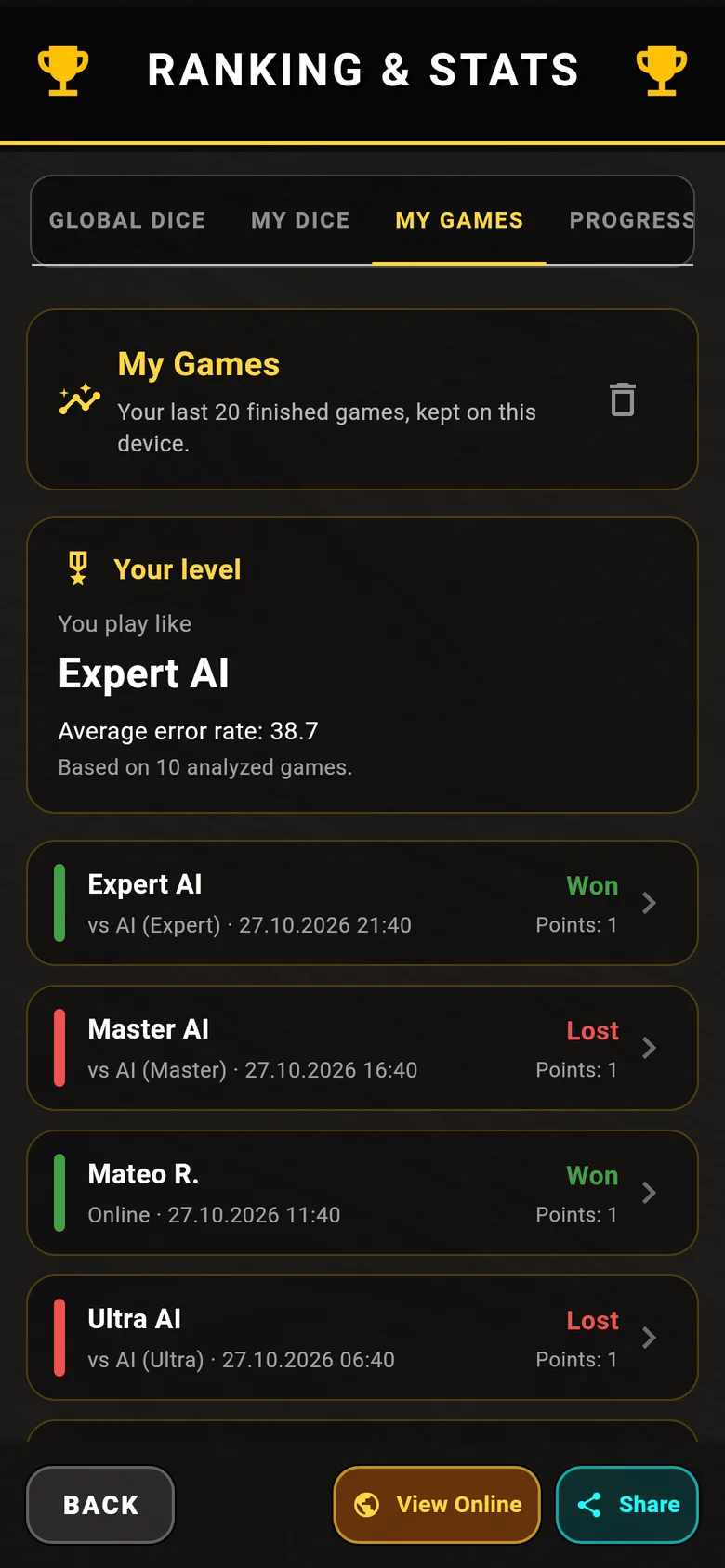
Open LEADERBOARDS 🏆 from the Main Menu and choose MY GAMES, right after MY DICE. Your games are listed newest first, with the opponent, the mode (vs AI with its level, Online or Same device), the date and the result: won or lost, gammon or backgammon, resignation or declined double, and the points of the game. Tap a game to open its Game Analysis.
Every game is saved automatically when it ends: against the AI, online and in Pass & Play. Games that stop early are kept too, marked Unfinished, with the reason: you left, the opponent left or the connection was lost. Only games cancelled within the first 6 rolls, which do not count for the rating, are left out. If you close the app in the middle of a game against the AI, the turns already played are saved with it, so the analysis covers the whole game once you finish.
What the analysis measures: equity, in plain words
Every verdict in My Games is based on equity: the number of points you can expect to win or lose from a position, on average, if the game were played out from there many times. A single win is worth +1, a gammon +2 and a backgammon +3; a loss is worth the same amounts with a minus sign. So equity always lies between -3 and +3. An equity of +0.40 means the position is worth, on average, almost half a point to you; -1.00 means you are losing a single game for sure.
When gammons are unlikely, equity and winning chances move together: every 0.02 of equity is about 1% of winning chances. That gives a simple way to feel the numbers: 0.04 of equity is about 2% winning chances, 0.08 about 4% and 0.16 about 8%. When a gammon is in play, the same equity can hide a bigger swing, because a move can also raise or lower the chance of losing double.
For every turn, Master compares the move you made with the best move available with the same dice. The difference between the two, the equity lost, is what decides whether your move was good, doubtful, a mistake or a blunder.
Doubtful move, mistake, blunder: what is the difference?
The verdict depends only on how much equity the move gave away compared with the best move. My Games uses the thresholds used by serious backgammon software:
• Good move: less than 0.04 equity lost, including the best move itself. Small differences like these are within the precision of any engine, so they are not marked.
• Doubtful move (yellow): from 0.04 to less than 0.08, about 2% to 4% winning chances. A slightly inaccurate choice, often between two reasonable plans.
• Mistake (orange): from 0.08 to less than 0.16, about 4% to 8% winning chances. A clear error: a better move was available and it mattered.
• Blunder (red): 0.16 or more, about 8% winning chances or more. A serious error that can turn a game on its own, such as leaving a direct shot without need, breaking your best point or missing a hit that wins the game.
So a blunder is simply a mistake that cost at least twice as much: it is not about how the move looks, only about how much it gave away. A move can look bold and be perfect, or look quiet and be a blunder.
The win probability graph: see where the game turned
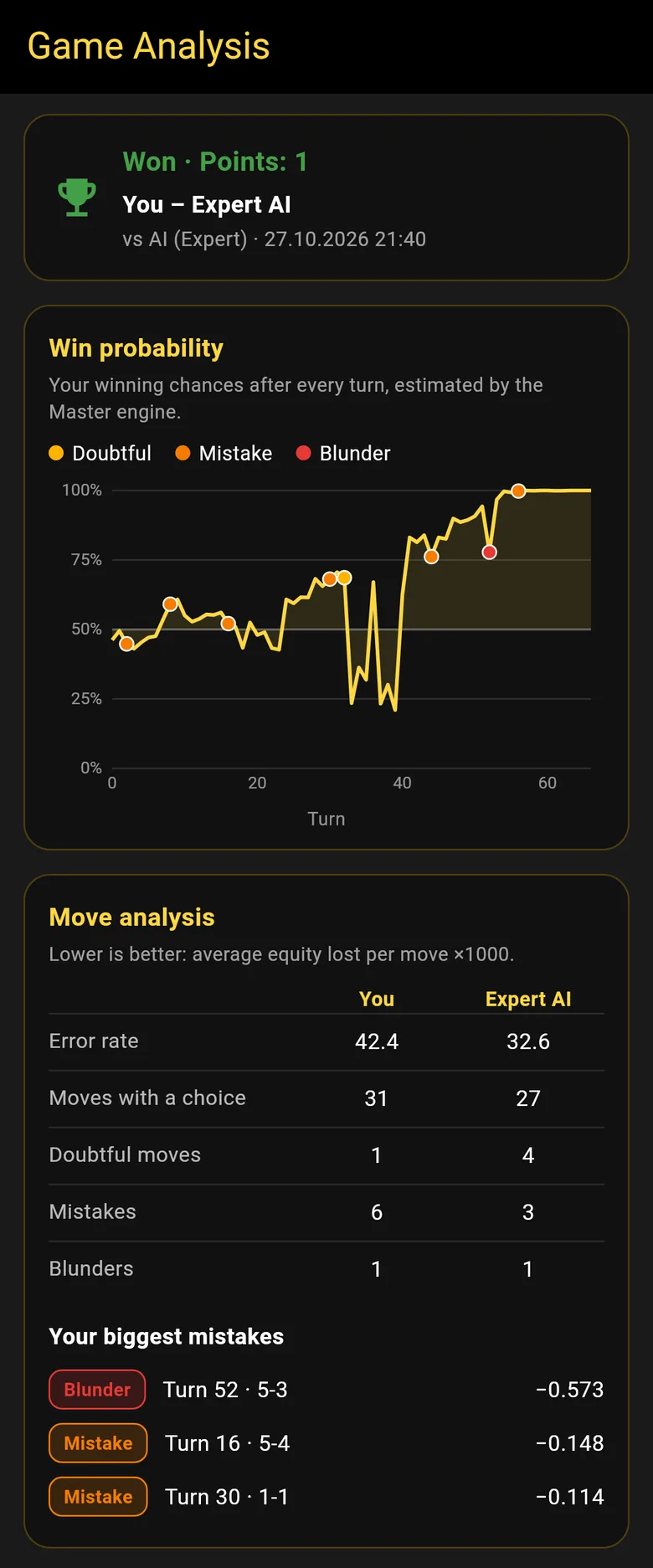
The first card of the analysis is a single line: your chance of winning before the first turn and after every turn, from 0% to 100%, always from your side. Above the 50% line you were ahead, below it you were behind. When the game ends the line goes to 100% if you won and 0% if you lost. A steep drop is usually a hit or a big roll for your opponent; a long slide is often a plan that did not work.
Coloured dots sit on the curve after your doubtful moves (yellow), mistakes (orange) and blunders (red); good moves have no dot. Look at where a dot comes right before a fall: that is the position worth remembering. Remember that the curve also moves with the dice, so a fall without a dot is just bad luck.
Move analysis: your error rate, side by side
The Move analysis card counts, for you and your opponent: the moves with a choice (turns where at least two different moves were possible), the doubtful moves, the mistakes and the blunders, and the error rate.
The error rate is the average equity lost per move with a choice, multiplied by 1000, so lower is better and 0 means every move was the best one. For example, 25 moves with a choice and 0.75 equity lost in total give 0.75 / 25 × 1000 = 30. The same numbers are shown for your opponent, which makes a fun comparison after an online game.
As a guide, here is the average error rate of the app’s own AI levels when their games are analysed by Master (100 games per level): Master AI 0, Ultra about 26, Expert 41, Hard 48, Medium 55, Easy 62. Master scores 0 because it is measured with its own engine.
Your level: which AI do you play like?
One game says little: the same Expert AI can score 18 in one game and 73 in the next, depending on how difficult its positions were. That is why the Your level card at the top of My Games waits for 10 analysed games; until then it tells you that your level appears after 10 analysed games.
From then on it takes all your moves with a choice from your saved games, computes one average error rate and shows the AI level whose average is the closest, from Easy AI to Master AI, together with your average error rate and the number of games it is based on. As My Games keeps your last 20 games, your level always follows your recent form.
Your biggest mistakes
Below the numbers, Your biggest mistakes lists your three worst moves of the game, worst first, with the turn, the dice and the equity lost. Only doubtful moves, mistakes and blunders appear here; if you have none, My Games says so: no mistakes found, well played! In a Pass & Play game the list shows the first player’s mistakes.
These three positions are the best homework you can get: note the turn and the dice, think about what else you could have played, and the next time a similar position comes up in a game against the AI, compare your idea with the hint.
Pip race and game summary
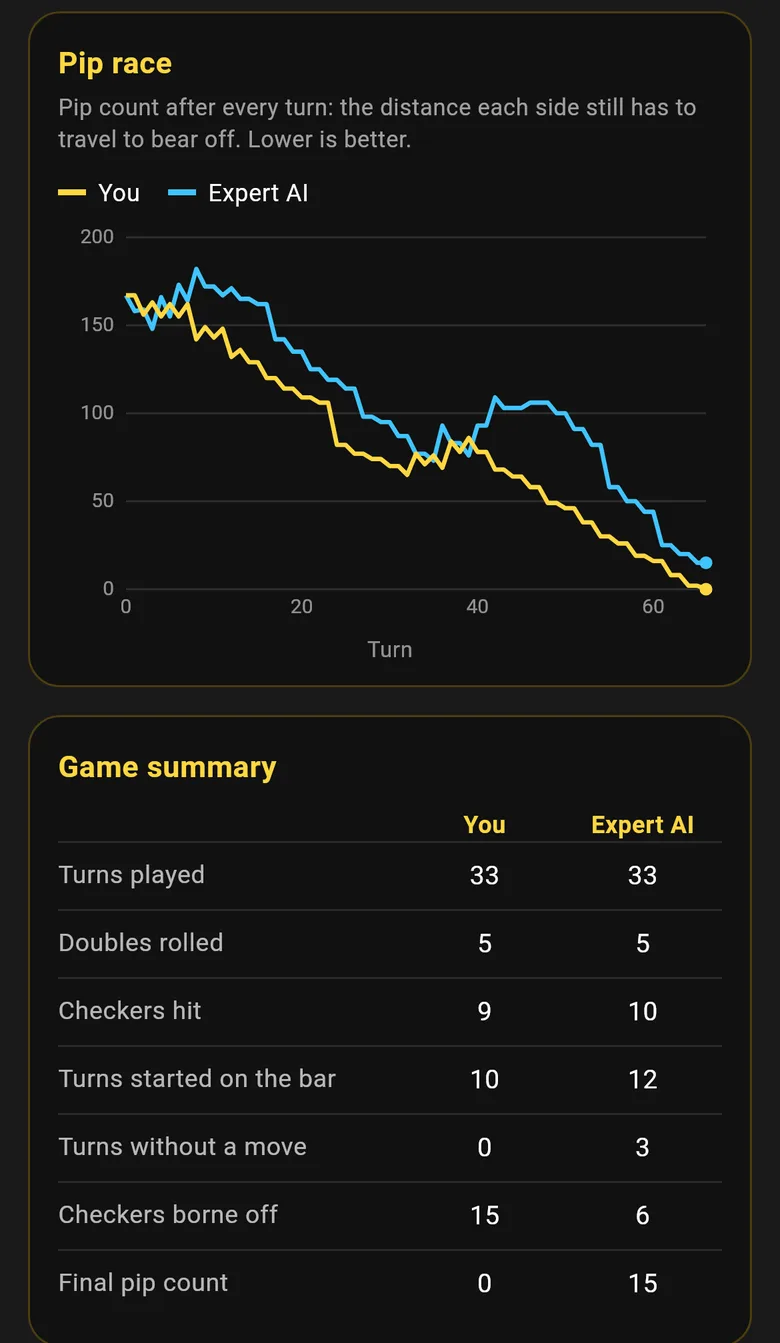
The pip race draws both pip counts after every turn: the distance each side still has to travel to bear off all its checkers. You can see who led the race, when a hit sent a checker back and how quickly the bear-off went. The pip race and the summary are available for every game, even before the analysis is ready.
The game summary puts the facts side by side: turns played, doubles rolled, checkers hit, turns started on the bar, turns without a move, checkers borne off and the final pip count. Luck is part of backgammon, and here you can see how the dice treated each side.
How the analysis works
Nothing is computed while you play. During a match the game only notes the board after each turn, so it never slows you down and never gives anyone an engine’s help. The analysis runs after the game, when you open it in My Games or in the background while the tab is open. Each game is analysed once and saved, so it opens instantly the next time; when the engine is improved, older analyses are simply done again.
For every turn, Master generates every legal move of the dice you rolled, evaluates each resulting position with its neural network and compares the move you made with the best one. A move that bears off your last checker is valued exactly: 1, 2 or 3 points. Turns with only one possible move (forced moves, or no move at all) are not judged and do not count in your error rate.
Your games stay on your phone. Nothing is sent to a server, and the bin icon at the top of My Games deletes them all whenever you like.
The limits of the analysis
• Cubeless. The analysis judges checker moves only. Offering, accepting or declining a double is not judged, although a declined double is shown as the result of the game.
• Estimates. Every position is evaluated once by the neural network, without looking further ahead. That is fast enough to run on a phone and good for spotting real errors, but very close decisions may be judged differently by deeper analysis. That is why differences under 0.04 count as good moves.
• Master judges itself. Against Master AI the opponent looks almost perfect, because it is measured with its own engine.
• Luck is not scored. My Games shows the dice in the summary and in the curve, but the verdicts only look at your decisions, never at the dice you rolled.
• One game is noisy. Trust your level and the trend of your error rate over many games more than the numbers of a single game.
A smarter hint, powered by Master
The light bulb you can use against the AI and in Pass & Play asks Master for its best move. It is the same engine that analyses your games: it always gives the same best move for the same position, and asking for a hint never changes how your AI opponent adapts to your style.
In the free version the first hint of every game is free and a short ad unlocks hints for the rest of a turn. With Pro, hints are unlimited.
Frequently asked questions
Q: What is the difference between a mistake and a blunder? Only the size of the error. A mistake gives away from 0.08 to less than 0.16 equity (about 4% to 8% winning chances); a blunder gives away 0.16 or more (about 8% or more).
Q: What is a doubtful move? A move that gives away from 0.04 to less than 0.08 equity, about 2% to 4% winning chances: not a clear error, but a better move was there.
Q: What does equity mean? The points you can expect from the position on average: +1 a win, +2 a gammon, +3 a backgammon, negative for a loss.
Q: What is a good error rate? Lower is better. Around 60 is the level of the Easy AI, around 41 the Expert AI, under 30 is close to the Ultra AI, and 0 would mean you always played Master’s move.
Q: Why does my level not appear? It needs 10 analysed games with real choices. Play a few more games and open My Games.
Q: Why is my opponent’s error rate 0? Most likely you played against Master AI, which is measured with its own engine.
Q: Why was my double not judged? The analysis is cubeless: it judges checker moves, not doubling decisions.
Q: Why is a forced move not counted? When only one move is possible there is nothing to choose, so it is neither good nor bad.
Q: Does My Games use the internet or cost anything? No. Everything is computed on your phone, after the game, and it is free.
How to learn from your games
• Start with the curve. Find the steepest fall in the win probability graph and look at the move just before it.
• Fix the blunders first. One blunder costs as much as four doubtful moves; removing them is the fastest way to lower your error rate.
• Study your three biggest mistakes. Note the turn and the dice, think about what else you could have played, and the next time a similar position comes up against the AI, compare your idea with the hint.
• Watch your level over time. One game is noisy; your level over 10 to 20 games tells you whether you are really improving.
Ready to play your next game and read its story? 👉 Get Clean Backgammon on Google Play or 👉 study the game in the Academy.